
The Children’s Attachment Wheel
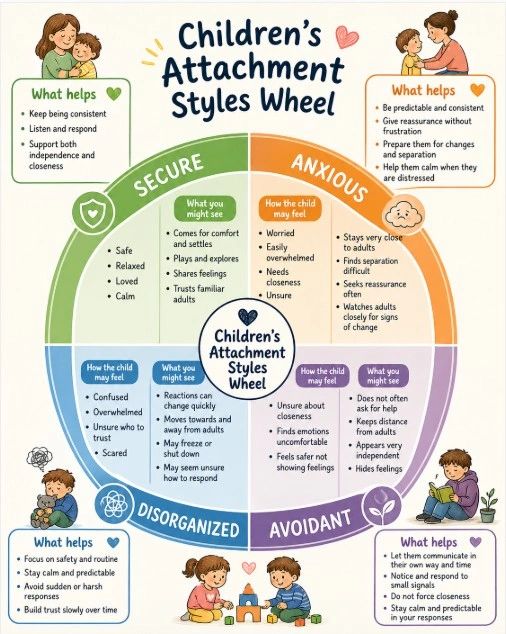
The Children’s Attachment Wheel: What You Might See, What They Might Feel, What Helps
Sometimes the moment doesn’t look “like attachment.”
It looks like a child clinging to your leg at drop-off.
It looks like a child who shrugs and says “I don’t care,” then melts down later over a broken cracker.
It looks like a child who runs toward you… then swats your hand away when you reach back.
It looks like a child who seems “fine” all day—until bedtime cracks something open.
But underneath behavior is often something simpler and more tender:
An attachment system asking, “Am I safe with you?”
That’s why I love this Children’s Attachment Styles Wheel—because it gives caregivers, helpers, and humans a way to translate behavior into what’s really happening inside. Not to label a child. Not to diagnose. But to respond with steadiness instead of panic, with curiosity instead of punishment.
Here’s the heart of it:
What you might see is the outside language.
How the child may feel is the inside experience.
What helps is the caregiver response that teaches the nervous system, “You don’t have to do this alone.”
Below is a gentle walk-through of the four patterns—woven with stories you can feel in your body.
1) Secure: “I can come close… and I can go play.”
What it can look like (a tiny scene):
A little one tumbles, scrapes a knee, and cries. They run to you, collapse into your lap, and you breathe with them. Their shoulders soften. Tears slow. A minute later, they slide off your knees and go back to the sandbox like nothing happened.
What’s happening inside:
Secure doesn’t mean a child never cries. It means they trust that comfort exists—and that they can return to the world.
What helps:
- Consistency that the body can rely on
- Listening and responding (especially to small signals)
- Supporting both independence and closeness
Sensation clue: when secure is present, the room feels settled. Breath drops lower. Shoulders unclench.
2) Anxious/Ambivalent: “Stay close… what if you leave?”
What it can look like (a tiny scene):
At preschool drop-off, a child’s arms tighten around your neck like a seatbelt. Their eyes track every movement you make. They ask the same question three times: “When are you coming back?” You answer—lovingly. And still, their body doesn’t believe it yet.
What’s happening inside:
This system learned that connection can be loving… but not always predictable. So the child watches for shifts, seeks reassurance often, and may feel overwhelmed by separation or change.
What helps:
- Predictability and consistency (clear routines, clear transitions)
- Reassurance without frustration (“I know you’re worried. I’m here.”)
- Preparing them for changes and separations ahead of time
- Helping them calm when distressed (co-regulation before correction)
Sensation clue: anxious attachment often feels like urgency—tight chest, fast questions, “right now” energy.
3) Avoidant: “I’m fine… I don’t need anything.”
What it can look like (a tiny scene):
A child falls, looks around quickly, then stands up and brushes it off. No tears. No request for help. Later, when you ask how they’re doing, they shrug. At home, they keep distance—even when they’re clearly tired.
What’s happening inside:
Avoidant patterns often form when needing wasn’t met consistently. The nervous system adapts by minimizing emotion and maximizing independence. It can look like “easy” behavior, but internally it may be “safer not to show it.”
What helps:
- Calm, predictable presence (no forced closeness)
- Time and patience—letting the child communicate in their own way
- Noticing and responding to small signals (the sideways glance counts)
- Offering connection without pressure: “I’ll be right here if you want me.”
Sensation clue: avoidant protection often shows up as numbness or “flatness”—a quiet shutdown rather than a loud protest.
4) Disorganized: “I want you… and I’m scared of you.”
What it can look like (a tiny scene):
A child runs toward you crying… then freezes. They move close, then suddenly push away. Their reaction changes quickly—almost like their body can’t decide which direction is safest. Sometimes they seem confused about how to respond at all.
What’s happening inside:
Disorganized attachment often forms when the nervous system experiences the caregiver (or caregiving environment) as both comforting and frightening/unpredictable. The system holds two competing instructions: seek safety and protect from danger. That contradiction creates overwhelm.
What helps:
- Safety and routine (structure is medicine here)
- Staying calm and predictable (your steadiness becomes their anchor)
- Avoiding sudden, harsh, or intense responses
- Building trust slowly over time (repair matters more than perfection)
Sensation clue: disorganized activation can feel like confusion in the body—hot/cold shifts, darting eyes, freeze, then burst of energy.
The most important thing this wheel teaches
A child’s behavior is not a character report.
It’s a nervous system report.
And your response—your tone, pacing, predictability, repair—teaches the child’s body what to expect from connection.
Not perfectly. Just consistently enough.
Tiny practice (30–60 seconds): “Regulate First”
Before you respond to the behavior, meet your own body.
- Feel your feet.
- Exhale slowly twice (longer out than in).
- Put one hand on your chest and silently say:
“I can be the steady one.” - Ask: “What is this child needing beneath the behavior?”
(closeness, space, reassurance, help, routine, repair)
Then respond from steadiness—not speed.
Reflection questions
- When a child is activated, what happens in my body first (tight chest, urgency, shutdown, irritation)?
- Which pattern do I default to under stress—pursuing, distancing, freezing, over-functioning?
- What would “consistent enough” look like in my home/classroom this week (one routine, one repair sentence, one calmer transition)?
- If I could translate behavior into a need, what would I say the child is asking for?
About the Author
Kristi M. Estrada, LPC-S, NCC, SEP is a Licensed Professional Counselor–Supervisor and Somatic Experiencing® Practitioner based in Phoenix, Arizona. She specializes in trauma-informed care, adult attachment theory, and post-traumatic growth—helping clients navigate life’s most challenging seasons with compassion, clarity, and steadiness. Kristi believes healing is not about “fixing” what’s broken, but about honoring each person’s story, returning to the body’s wisdom, and building the capacity to live with greater peace and self-worth. Her work integrates nervous system regulation, somatic practices, and relational healing to create a safe, supportive space for transformation.
Connect: @healingservant.com
Educational/Reflection Disclaimer: This reflection is for educational and reflective purposes only and is not a substitute for therapy, medical care, diagnosis, or crisis support. If you feel overwhelmed or unsafe, please seek support from a qualified professional or local resources..