
When Power Replaces Regulation
What David’s story reveals about shame, nervous-system survival, and the cost of delayed repair
(Part 2 of the David + Attachment Series)
If you missed Part 1, start here:
David Was Loved by God — and Still Unsafe at Times
If you want the visual map for this series:
David’s Family System: A Trauma-Informed Genogram
There is a moment in many families and many leadership stories where something shifts.
It usually does not happen with a dramatic announcement.
It happens inside a body.
A person feels overwhelmed. Exposed. Ashamed. Powerless.
Their nervous system cannot tolerate what is happening internally.
So they reach for what they can control externally.
This is one of the most common trauma patterns I see in therapy, and one of the most misunderstood:
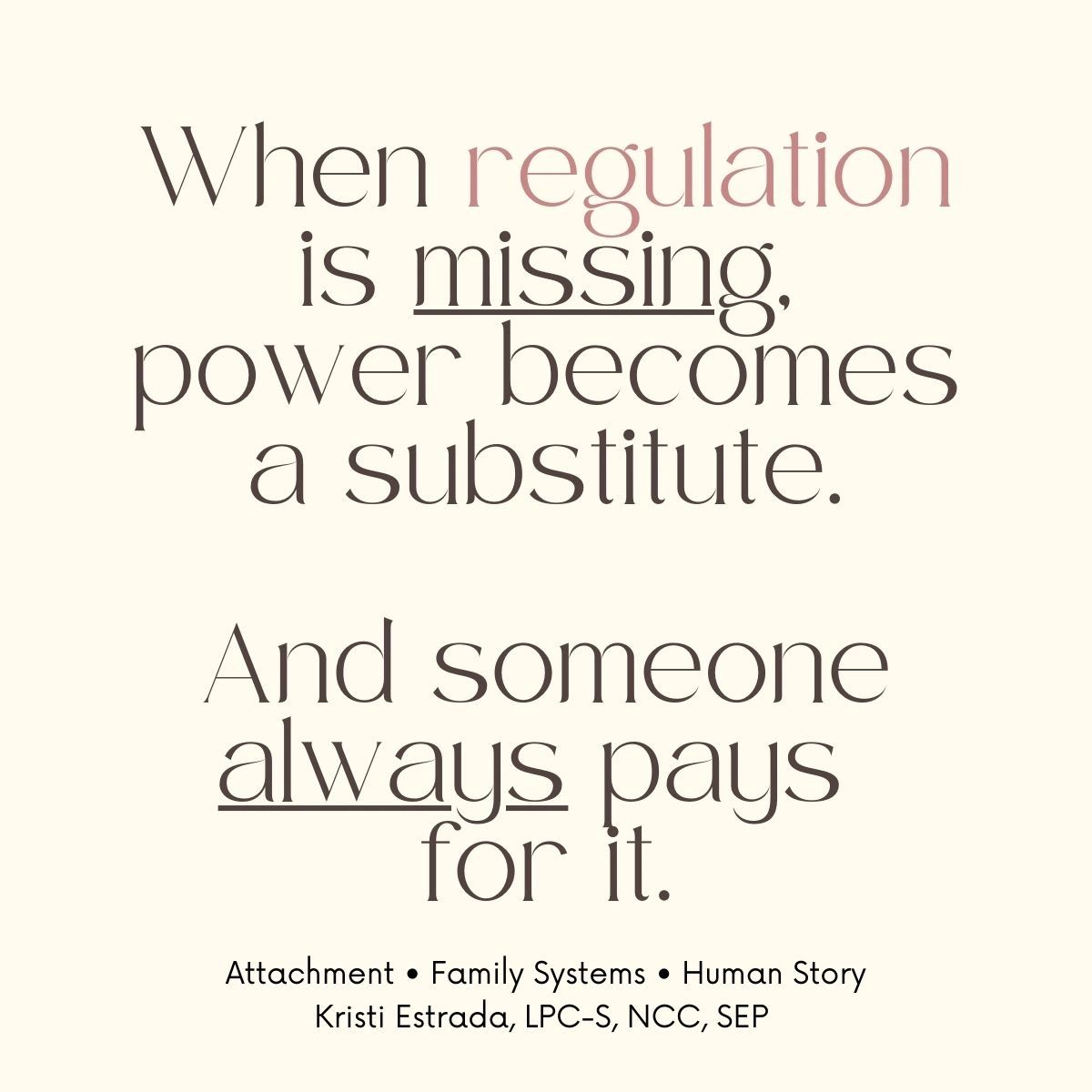
When regulation is missing, power becomes a substitute.
Not always with cruelty.
Sometimes with charisma.
Sometimes with competence.
Sometimes with spiritual language.
Sometimes with silence.
But underneath it, the same thing is happening:
A human being is dysregulated.
And instead of returning to connection, they reach for control.
When power replaces regulation, people get hurt.
And systems reorganize to survive.
David’s story shows us that with a kind of honesty most of us are not used to seeing, especially in spaces where we are taught to “honor leaders” and hurry to resolution.
A Trauma-Informed Reframe
Many people read David’s most painful moments and stop at morality.
What did he do wrong?
What rules did he break?
What consequences followed?
Those questions matter.
Trauma-informed care also asks:
- What was happening inside his nervous system before he reached for power?
- What did shame do to his capacity for presence and repair?
- What happens to a family system when the leader is dysregulated and unaccountable?
Because here is a truth that is hard to say without flinching:
You can be deeply gifted and deeply wounded at the same time.
You can be spiritually devoted and still use power to manage pain.
Not because you are “all bad.”
Because when the nervous system is overwhelmed, it will reach for strategies.
And power is a strategy.
What I Mean by “Power Replacing Regulation”
Regulation is the capacity to stay present in yourself while staying connected to others.
It is the ability to feel what you feel without making it someone else’s job to carry.
It is the ability to pause before acting.
It is the ability to repair after rupture.
Power, when used as a substitute for regulation, becomes a shortcut.
A way to escape vulnerability.
A way to outrun shame.
A way to keep the inside from being seen.
Power can look like:
- controlling the narrative
- demanding respect without a relationship
- escalating authority instead of slowing down
- shifting blame to avoid accountability
- using faith, expertise, money, or status to shut down discomfort
- making someone else the problem, so you do not have to feel what is happening inside
Sometimes power is loud.
Sometimes it is quiet.
Sometimes it shows up as “I’m fine,” but said with a locked jaw and a closed heart.
Sometimes it shows up as “We’re not talking about that.”
Sometimes it shows up as spiritual certainty used to avoid relational repair.
It is still the same nervous-system move:
“I cannot tolerate what I feel, so I will control what happens.”
David’s Pattern: Shame, Avoidance, and Control
In Part 1, we talked about David’s early emotional invisibility and how that can shape an adult toward self-reliance and withdrawal under shame.
That matters here.
Shame does not just make people feel bad.
Shame often collapses the nervous system.
For many people, shame triggers one of two strategies:
- Hide (withdraw, avoid, disappear)
- Control (dominate, manage, override)
David shows both.
When repair is needed, David often withdraws.
When desire and power collide, David controls.
What begins as dysregulation becomes relational harm.
And when harm is not repaired, it becomes a pattern that travels through the system.
Modern Translation: This Is Not Just a Bible Story
You do not have to be a king to use power as a regulation strategy.
You just have to be human and overwhelmed.
In modern life, “power replacing regulation” can look like:
In families
- A parent who cannot tolerate conflict, so they punish instead of repair
- A caregiver who shuts down emotionally and then demands closeness later
- A home where truth is treated like betrayal and silence is called “peace”
- A family where one person’s discomfort determines what everyone else is allowed to feel
In relationships
- One partner who uses intimidation, withdrawal, sexuality, money, or spiritual authority to avoid vulnerability
- Apologies without change
- Repair never happening because someone refuses to be wrong
- Consent blurred because one person’s needs dominate the system
In leadership and workplace culture
- Leaders who cannot tolerate feedback, so they control through fear, image, or blame
- Teams that become hypervigilant because the leader’s nervous system is unpredictable
- “We’re a family here” used as a reason people should not have boundaries
This is why trauma-informed work matters.
Because without nervous-system awareness, power becomes the language of the unregulated.
The Cost to the System
Family systems theory teaches us that what the leader will not hold, the system will distribute.
If the leader cannot hold shame, someone else will carry it.
If the leader cannot hold accountability, someone else will become the scapegoat.
If the leader cannot hold grief, someone else will act it out.
This is how children and adults become roles:
- the responsible one
- the invisible one
- the caretaker
- the angry one
- the “problem”
- the truth-teller who gets punished for telling the truth
Not because they are defective.
Because the system needed somewhere to put what the leader could not metabolize.
A Tender Truth for Those Who Have Been Harmed
Some of you were harmed by someone who loved God.
Some of you were harmed by someone who believed they were doing the right thing.
Some of you were harmed in a home where faith was present, but safety was not.
If that is your story, this is not me excusing harm.
This is me naming something that may loosen shame inside you:
It makes sense that you felt confused.
It makes sense that you felt unsafe.
It makes sense that you learned to go quiet, to perform peace, to carry the emotional truth alone.
Your body was not being dramatic.
Your body was telling the truth.
What Repair Requires
Repair is not an apology without change.
Repair is not spiritual language used to skip accountability.
Repair is the willingness to return, to name what happened, to take responsibility, and to rebuild trust through consistent action over time.
Repair requires:
- emotional presence
- humility
- nervous-system capacity
- the ability to tolerate discomfort without dominating others
- a commitment to truth even when it costs your image
This is why healing is slow.
Not because you are weak.
Because nervous systems learn safety through repetition.
This Week’s Reflection
If you want one question to carry this week, let it be this:
When I feel exposed or overwhelmed, do I move toward repair or toward control?
No judgment.
Just information.
A Somatic Practice
(Optional, 1–2 minutes)
- Orient: Let your eyes slowly scan the room. Find three neutral or pleasant objects.
- Name the body: Notice jaw, shoulders, belly, hands. Where is there gripping?
- Lengthen the exhale: Exhale longer than you inhale, two or three times.
- One sentence: Whisper quietly,
“I can be with discomfort without becoming controlling.”
If your body says “not today,” honor that.
Safety begins with consent, even inside your own practice.
Next in the Series
Part 3: When Silence Becomes the Peace Offering (coming next)
Because after power, the next pattern many systems reach for is silence.
And silence can look like peace until you notice who is paying for it.
About the Author
Kristi M. Estrada is a trauma-informed therapist, Somatic Experiencing Practitioner (SEP), and clinical supervisor who writes at the intersection of attachment, nervous system healing, faith, and lived human experience. She is the founder of The Healing Servant Team in Phoenix, Arizona, where she offers attachment-based, somatic, and trauma-restorative care to individuals and families.
Through her blog, teaching, and therapeutic practice, Kristi invites readers to approach their stories with greater kindness, curiosity, and courage, believing that healing does not require perfection, only presence and repair.
Learn more at healingservant.com.